
Hide
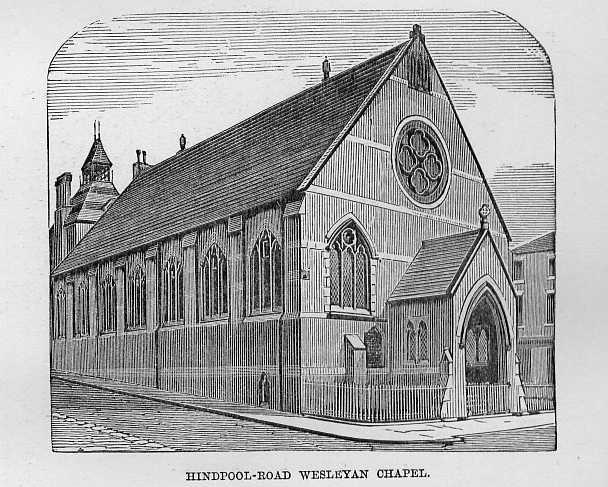
Hindpool Road Wesleyan Methodist, Barrow in Furness
hide
Hide
Hide
Wesleyan Methodist church,
Hindpool Road,
Barrow in Furness
Lancashire

Hide

The church was erected 1862 and opened 3 November 1862. It was enlarged in 1870 and finally closed in 1935.
The Wesleyan Chapel, Hindpool Road, was built in 1862, and was the first one erected by that denomination. Previous to this time they used to meet for worship in a room in Church Street. The building has been much enlarged since its first erection, and will now accommodate 700 people. The disciples of the fervent and zealous Wesley do not effect the ornate or florid in their religious edifices, and Hindpool Road Chapel does not deviate from this canon of their founder. It is a brick building of plain Gothic architecture, and cost (including its various enlargements) about £6,000. The Wesleyans have also another chapel in Hartington Street, opened in 1874, and capable of seating 300 persons. In Abbey Road and Greengate Street are two temporary structures of corrugated iron, accommodating respectively 200 and 150. These were opened in 1876, but will in time be replaced by permanent buildings. The Rev. Amos White and the Rev. T. Hitchon are the ministers. The Wesleyan Schools are situated in Dalton Road, and are used as Day and Sunday Schools. They were opened in 1868, and are attended by about 600 scholars. Classes for the study of navigation, nautical astronomy, and other subjects required by the Board of Trade are held during the winter season by the head master, Mr. Pentreath.from Mannex's directory of Furness & Cartmel, 1882
The building is still standing and has been used as a Night Club for a number of years - seems to keep changing its name, but currently 'Scorpio'. One end faces onto Hindpool Road; the road alongside is known as Wesley Place. The other end faces onto Barrow Town Hall.
The Wesleyan Methodist church was formed in the 18th century from religous societies founded by John Wesley and his preachers. It suffered many secessions, but was the largest Nonconformist denomination in the 19th century. In 1932 the Wesleyan Methodists joined with the Primitive Methodists and the United Methodists to form the Methodist Church of Great Britain.
Whilst every effort has been made to record exact details of record office and library holdings you are recommended to check with them before visiting to ensure that they do hold the records and years you wish to examine. Similarly check with transcript publishers to ensure they cover the records and years you require before making a purchase.
The Cumbria Record Office, Barrow hold:
- Baptisms 1862-1935
- Marriages 1899-1935
This site provides historical information about churches, other places of worship and cemeteries. It has no connection with the churches themselves.
- OpenStreetMap
- Google Maps
- StreetMap (Current Ordnance Survey maps)
- Bing (was Multimap)
- Old Maps Online
- National Library of Scotland (Old Ordnance Survey maps)
- Vision of Britain (Click "Historical units & statistics" for administrative areas.)
- English Jurisdictions in 1851 (Unfortunately the LDS have removed the facility to enable us to specify a starting location, you will need to search yourself on their map.)
- Magic (Geographic information) (Click + on map if it doesn't show)
- GeoHack (Links to on-line maps and location specific services.)