
Hide
Trinity Presbyterian, Barrow in Furness
hide
Hide
Hide
Trinity,
School St,
Barrow in Furness
Lancashire
Hide

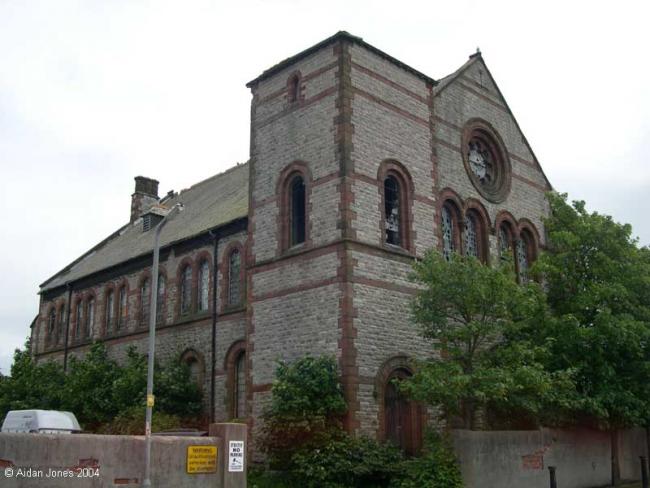
It was founded in 1867. The church opened 8 July 1875, the mainly Scots congregation having begun meeting in 1865 at the Welsh Chapel. Administrative union with St Andrews Presbyterian Church, Walney, in 1960, to form the Furness Presbyterian Church. Following the general union of the Congregationalists and the English Presbyterians in 1971 (to create the United Reformed Church), the remaining Trinity congregation was linked to the Emmanuel Congregational Church and Trinity Church was closed, although the church hall continued in use for other functions for some years afterwards.
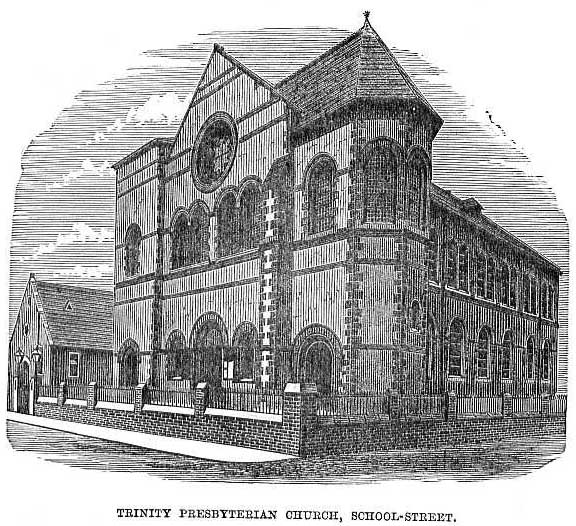
Trinity Presbyterian Church, situated in School Street, is a large, handsome structure, built of limestone, with red freestone dressings and bands of the same material. The architects were Messrs. Paley and Austin, of Lancaster. The site was presented by Sir J. Ramsden, and the total cost of erection over £5,000. The style is Italian or Romanesque, and though little or no floral ornamentation has been attempted, yet the church presents an attractive appearance. All the woodwork is of pitch pine, varnished, and the pews combine both comfort and elegance. The sitting accommodation is increased by a gallery, which runs round the whole church. At one side is the first instalment of a tower, and the front is lighted by a circular window, surrounded by heavy moulding. The church was begun in 1874, and opened by Professor Cairns in July the following year. Near the church is a Lecture Hall, built in 1868, at a cost of £1,400, in which service was held previous to the erection of the church. The Rev. Wm. Ferguson, minister.
from Mannex's directory of Furness & Cartmel, 1882
The building was destroyed by fire on Saturday 19th March 2005.
The Presbyterian church was influenced by Calvinism which rejected bishops and believed that the church should be governed by a hierarchy of general assembly, synod, presbytery and kirk sessions attened by ministers and elders of equal rank. Presbyterianism flourished in the 17th and early 18th centuries but in the later 18th century many Presbyterian churches adopted Unitarianism.
In 1972 the Presbyterian Church of England merged with the Congregational Church to form the United Reformed Church.
Whilst every effort has been made to record exact details of record office and library holdings you are recommended to check with them before visiting to ensure that they do hold the records and years you wish to examine. Similarly check with transcript publishers to ensure they cover the records and years you require before making a purchase.
The Cumbria Record Office, Barrow hold:
- Baptisms 1868-1960
This site provides historical information about churches, other places of worship and cemeteries. It has no connection with the churches themselves.
- OpenStreetMap
- Google Maps
- StreetMap (Current Ordnance Survey maps)
- Bing (was Multimap)
- Old Maps Online
- National Library of Scotland (Old Ordnance Survey maps)
- Vision of Britain (Click "Historical units & statistics" for administrative areas.)
- English Jurisdictions in 1851 (Unfortunately the LDS have removed the facility to enable us to specify a starting location, you will need to search yourself on their map.)
- Magic (Geographic information) (Click + on map if it doesn't show)
- GeoHack (Links to on-line maps and location specific services.)