
Hide
St Mary of Furness Roman Catholic, Ulverston
hide
Hide

Hide
Hide

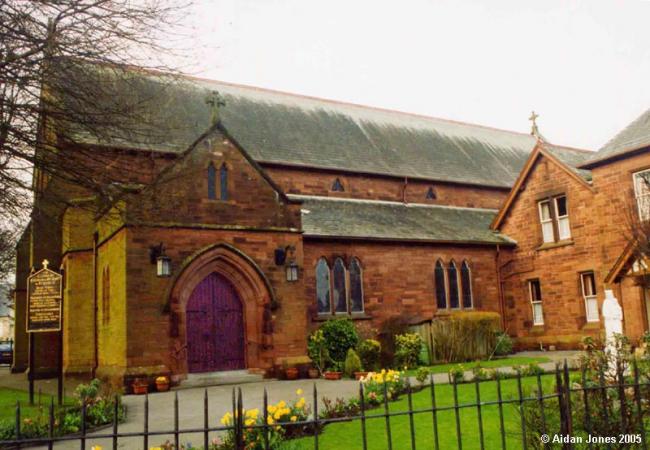
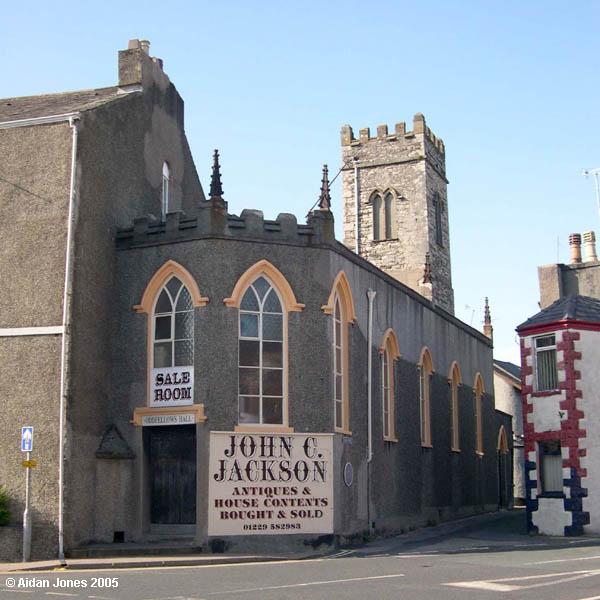
The Catholic Church, under the invocation of the Blessed Virgin, patroness of Furness, is a narrow, plain Gothic edifice, at the corner of Fountain Street. The foundation stone, which was taken from Furness Abbey, was laid on the Feast of SS. Peter and Paul, June 29th, 1822. From the period of the Reformation to the erection of this church, the Catholics of Furness had no ecclesiastical edifice, and the few scattered members of the old creed must have had long distances to travel to fulfil the obligations of their faith. The first priest of the mission was the Rev. B. M'Hugh, who, in conjunction with the Rev. Dr. Everard, afterwards Archbishop of Cashel, received a few gentlemen boarders into their house for the purpose of completing their education. In 1832, the small tower at the east end was erected. The chancel is the only portion of the church which has received any ornamentation ; the window, by which it is lighted, is filled with stained glass, representing the Crucifixion, Resurrection, Ascension of Christ, and the Descent of the Holy Ghost in the central compartments, and the twelve apostles in the others.The original church was locatedAfter the death of the Rev. B. M'Hugh, the mission was placed under the care of the Jesuit fathers, and upon their resignation of the charge, Father Laverty entered upon the mission, where he laboured most assiduously among his poor flock until the infirmities of age compelled his retirement from active service. The church is much too small for the congregation, and it is intended to build a new one, and also presbytery and school, towards the cost of which 1,400 has already been subscribed. The present pastor is the Rev. William Massey. Near the church is the school, attended by about 105 children. It is under the care of the Misses Potter.
from Mannex's directory of Furness & Cartmel, 1882
This site provides historical information about churches, other places of worship and cemeteries. It has no connection with the churches themselves. For current information you should contact them directly.
Original Registers
Baptisms
- 1812-1880 held by Lancashire Record Office RCUL
- 1812-1880 held by Lancashire Record Office RCUL
Marriages
- 1822-1897 held by Lancashire Record Office RCUL
- 1822-1897 held by Lancashire Record Office RCUL
Burials
- 1845-1872 held by Lancashire Record Office RCUL
- 1845-1872 held by Lancashire Record Office RCUL
Copies of Original Registers
Baptisms
- 1812-1843 Catholic Record Society held by Lancashire Record Office CRS 20 - Printed
- 1812-1843 Catholic Record Society held by Lancashire Record Office CRS 20 - Printed
Marriages
- 1822-1844 Catholic Record Society held by Lancashire Record Office CRS 20 - Printed
- 1822-1844 Catholic Record Society held by Lancashire Record Office CRS 20 - Printed
Baptisms
1812-1843
1812-1880
Marriages
1822-1844
1822-1897
- OpenStreetMap
- Google Maps
- StreetMap (Current Ordnance Survey maps)
- Bing (was Multimap)
- Old Maps Online
- National Library of Scotland (Old Ordnance Survey maps)
- Vision of Britain (Click "Historical units & statistics" for administrative areas.)
- English Jurisdictions in 1851 (Unfortunately the LDS have removed the facility to enable us to specify a starting location, you will need to search yourself on their map.)
- Magic (Geographic information) (Click + on map if it doesn't show)
- GeoHack (Links to on-line maps and location specific services.)
- OpenStreetMap
- Google Maps
- StreetMap (Current Ordnance Survey maps)
- Bing (was Multimap)
- Old Maps Online
- National Library of Scotland (Old Ordnance Survey maps)
- Vision of Britain (Click "Historical units & statistics" for administrative areas.)
- English Jurisdictions in 1851 (Unfortunately the LDS have removed the facility to enable us to specify a starting location, you will need to search yourself on their map.)
- Magic (Geographic information) (Click + on map if it doesn't show)
- GeoHack (Links to on-line maps and location specific services.)