
Hide
Little Bytham
hide
Hide
hide
Hide
hide
Hide
Hide
Hide

The parish erected a recreation and reading room in 1900 mde of corrugated iron.
The Library at Bourne should prove useful in your research.
- The churchyard was enlarged in 1904.
- Richard CROFT has a pohotograph of the churchyard headstones on Geo-graph, taken in March, 2010.
- Rex NEEDLE has a photograph of the church graveyard, including the War Memorial on Geo-graph, taken in March, 2009.
- Robert HARVEY also has a picture of a part of the Churchyard on Geo-graph, taken in August, 2018.
- The parish was in the Corby sub-district of the Bourne Registration District.
- Check our Census Resource page for county-wide resources.
- The table below gives census piece numbers, where known:
| Census Year | Piece No. |
|---|---|
| 1841 | H.O. 107 / 615 |
| 1851 | H.O. 107 / 2095 |
| 1861 | R.G. 9 / 2315 |
| 1871 | R.G. 10 / 3311 |
| 1881 | R.G. 11 / 3195 |
| 1891 | R.G. 12 / 2555 |
| Little Bytham, Methodist (Wesleyan) |
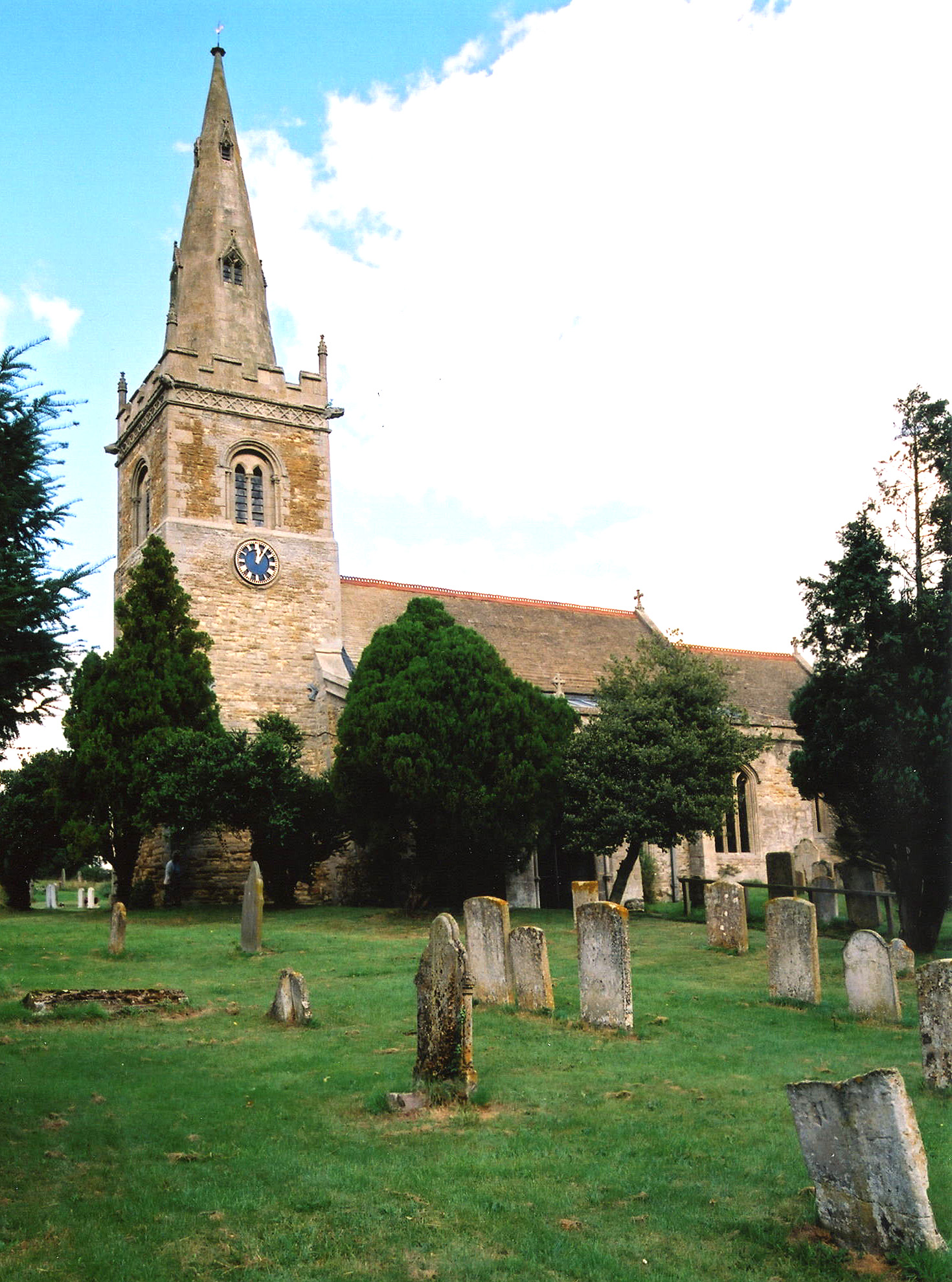
- The Anglican parish church is dedicated to Saint Medardus (or "Medard") and Saint Gildard, two 6th century French saints.
- Parts of the church appear to date from circa 1000.
- The church tower dates from around 1225.
- The church was restored in 1875.
- The Tower Clock was installed in 1903.
- Some time in the 1700 or 1800s, the name "Saint Gildard" was dropped, but local historians had it restored in 1999.
. - The church is a Grade I listed building with British Heritage.
- The church seats 144.
- Tim HEATON has a photograph of the Church of St Medard and St Gildard on Geo-graph, taken in May, 2006.
- Here is a photo of St. Medard's Church, taken by Ron COLE (who retains the copyright):
- The Anglican parish registers exist from 1681 and the Bishop's Transcripts from 1561.
- The Lincolnshire Archives have the Parish Register for these dates: Baptisms 1681-1930, Marriages 1681-1926, Burials 1681-1849.
- The Lincolnshire Archives have the Bishop's Transcripts for this parish, but, as of 2012, they were not catalogued properly. The Family History Library in Salt Lake City has the BTs from 1561 through 1838. These can be ordered on Microfilm.
- The Lincolnshire FHS has published several marriage indexes and a burial index for the Beltisloe Deanery to make your search easier.
- The Wesleyan Methodists built a chapel here in 1880. For information and assistance in researching these chapels, see our non-conformist religions page.
- Check our Church Records page for county-wide resources.
- The parish was in the Corby sub-district of the Bourne Registration District.
- Check our Civil Registration page for sources and background on Civil Registration which began in July, 1837.
Little Bytham is both a village and parish which lies 92 miles north of London, 8 miles north of Stamford, 7 miles east of Bourne and 4 miles south of Corby Glen. Castle Bytham parish lies to the west and Creeton parish to the north. The parish covers just over 1,230 acres.
The village is called "an ancient village on an acclivity" in the early directories of 1800. The River Tham flows through the village and on toward the River Witham. The West Glen River passes just east of the village. If you are planning a visit:
- By automobile, the village lies just east of the A1 trunk road.
- Check the bus schedules at Transport Services. Beware, some routes do not have scheduled stops in Little Bytham, they just pass through the village. Remember to ask the driver if they stop (or will stop) there.
- The village Hall is on High Street, postal code NG33 4QX.
- There is a caravan park just northwest of the village.
- Some travellers will prefer the Willougby Arms for a meal and beverage. They are on Station Road.
- You might need a refreshing pint of ale care of the Newby Wyke Brewery.
- Keep up with events by visiting The Bythams website.
- See our touring page for visitor services.
- Ask for a calculation of the distance from Little Bytham to another place.
- Clay was worked into pottery here in Roman times.
- The "Adamantine Clinker & Fireclay Company" were the 20th century followup in making firebricks.
- The main line of the Midland and Great Northern is considered to begin at a point near Little Bytham, where it is connected with the L.M.S. branch from Saxby. It crosses the L.N.E.R. and runs via Bourne, Sutton Bridge, South Lynn, Fakenham, and Melton Constable, to Cromer. This line carries the express trains from the Midlands to the East Coast.
- Richard CROFT has a photograph of The Mallard Pub. on Geo-graph, taken in March, 2010. Richard's description has some interesting history notes.
- The parish holds an annual village feast on or near St. Medard's day, June 8th.
- See our Maps page for additional resources.
You can see maps centred on OS grid reference TF013180 (Lat/Lon: 52.750133, -0.500634), Little Bytham which are provided by:
- OpenStreetMap
- Google Maps
- StreetMap (Current Ordnance Survey maps)
- Bing (was Multimap)
- Old Maps Online
- National Library of Scotland (Old Ordnance Survey maps)
- Vision of Britain (Click "Historical units & statistics" for administrative areas.)
- English Jurisdictions in 1851 (Unfortunately the LDS have removed the facility to enable us to specify a starting location, you will need to search yourself on their map.)
- Magic (Geographic information) (Click + on map if it doesn't show)
- GeoHack (Links to on-line maps and location specific services.)
- All places within the same township/parish shown on an Openstreetmap map.
- Nearby townships/parishes shown on an Openstreetmap map.
- Nearby places shown on an Openstreetmap map.
- A cross was erected in the churchyard in memory of the men of the parish who perished in World War I.
- Jonathan THACKER has a photograph of the War Memorial in the churchyard on Geo-graph, taken in March, 2020.
A local lad, Sapper William Bernard PEARSON, died in July, 1917. Born in Little Bytham his parents made sure that his memorial was in this parish, even though they had moved to Stamford at the time of his death.
Other names on the War Memorial list:
- Allen, Thomas Henry
- Chamberlain, Ernest
- Chambers, Thomas
- Couzens, Charles
- Edinborough, Henry William
- Holmes, John
- Mason, Harry Gordon
- Pearson, Bernard (Is this Willam/William?)
- Pepper, John
- Spenlove, Leonard
- Staniland, Leonard Wilmot
- Steel, Percy
- Bytham is from the Old English bythme or "valley bottom," and the name first appears in 1067 as Bytham and in the 1086 Domesday Book as Bitham.
[A. D. Mills, "A Dictionary of English Place-Names," Oxford University Press, 1991].
- Locals pronounce the name as "Bye-Tham".
- This place was an ancient parish in Lincoln county and became a modern Civil Parish when those were established.
- The parish was in the ancient Beltisloe Wapentake in the South Kesteven district in the parts of Kesteven.
- Robert HARVEY has a photograph of the Village Hall on Geo-graph,taken in December, 2013. You'll want to see the Schedule of Forth-coming events.
&nbap; - You may contact the Parish Council regarding civic or political issues, but they are NOT funded to help you with family history searches.
- For today's district governance, contact the South Kesteven District Council.
- Bastardy cases would be heard in the Bourne petty session hearings.
- As a result of the 1834 Poor Law Amendment Act reforms, this parish became part of the Bourne Poor Law Union.
Returns from 1086 are from the Domesday Book. 1991 is an estimate.
Year Inhabitants 1086 150 1801 189 1831 237 1841 300 1871 324 1891 482 1901 378 1911 419 1991 265
- By 1841 there was a school here, supported by Mrs. REYNARDSON, for the education of 22 poor girls. The 1841 schoolmistress was Elizabeth ATTON.
- In 1877 a Pulic Elementary School for 120 children was built here.
- See our Schools page for more information on researching school records.