
Hide
Brough
hide
Hide
hide
Hide
Hide
Hide
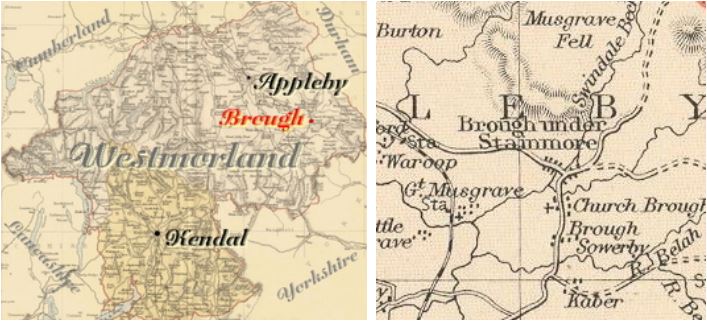
"BROUGH-under-STAINMOOR, or BURG, a parish in EAST ward, county of WESTMORLAND, comprising the market-town of Brough, the chapelry of Stainmore, the townships of Brough-Sowerby and Hilbeck, and part of the township of Kaber, and containing, exclusively of Kaber, 1837 inhabitants, of which number, 940 are in the town of Brough, 8 miles (S. E. by E.) from Appleby, and 262 (N. N. W.) from London, on the high road to Glasgow. . . . The town, divided into Market-Brough and Church-Brough, is pleasantly situated, and is crossed by the Swindale Beck, which flows into the river Eden: it consists principally of one long street; the houses are rather commodious than handsome; the inhabitants are well supplied with water. . . . This parish was formerly a chapelry within the parish of Kirkby-Stephen: the living is a vicarage, in the archdeaconry and diocese of Carlisle, rated in the king's books at £8. 8. 9., endowed with £200 private benefaction, and £200 royal bounty, and in the patronage of the Provost and Fellows of Queen's College, Oxford, to whom the rectory and advowson were given, at the request of Robert Egglesfield, founder of that college, and for several years rector of this parish. The church, dedicated to St. Michael, is a large handsome structure of great antiquity"
[From Samuel Lewis A Topographical Dictionary of England (1831) - copyright Mel Lockie 2016]
Hide

M.I.s for Brough were transcribed in Monumental Inscriptions of Westmorland by E. Bellasis 1888-89 and are available on Westmorland Papers.
Returns do not survive for the 'census' of 1787 except for the constablewick of Stainmore.
Census returns are available from the usual sources for 1841-1911.
Transcript and index for 1851 has been published by the Cumbria Family History Society and also in 'North Westmorland - An Index to the 1851 Census' compiled by David Lowis and Barbara Slack.
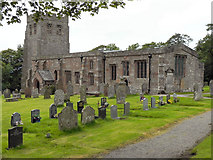 | St Michael S side of nave Norman. C14th arcade. C16th W tower. Later chancel. This and other photographs on the Geograph site Historical and architectural notes on National Heritage List (English Heritage site). Photograph(s) and description on VisitCumbria. Access and contact details on Church of England site More details and maps in Genuki Westmorland Church Database |

| Wesleyan Methodist chapel. |
Parish Registers and Bishop's Transcripts are held by Cumbria Archives :
originals at Kendal RO and microfilm copies at Carlisle RO.
| Baptism registers | 1559-1945 |
| Marriage registers | 1559-1957 |
| Banns registers | 1756-1817 |
| Burial registers | 1559-1927 |
| Bishops transcripts | 1661-1874 |
See the CASCAT online calogue for WPR23A for information on these and other parish records..
For searching on LDS familysearch.org see IGI batch numbers (compiled by Jake Prescott)
or use the batch number search site (by Hugh Wallis).
Baptisms and marriages for 1662-1777 are indexed on the LDS Vital Records CD.
The Primitive Methodist circuit registers for Brough are located in the Kendal Record Office.
Nicolson and Burn: The history and antiquities of the counties of Westmorland and Cumberland. 1777. Transcribed by Anne Nichols.
"The parish of Brough was anciently part of the parish of Kirkby Stephen, even as Gresmere and Windermere were parts of the parish of Kendal. For parishes in England were not set out all at once, but the boundaries became ascertained by usage, or special agreement, or the extent sometimes of the founder's estate. The parish of Brough is bounded on the East by the parishes of Romaldkirk and Bowes in the county of York; on the South, by the parish of Kirkby Stephen; on the West, by the parish of Musgrave; and on the North, by the said parish of Romaldkirk: And contains about 210 families, all of the church of England [in 1777]. The church is dedicated to St. Michael; and is a vicarage. The church at Brough is a pretty large handsome ancient building. The steeple is not so old; having been built about the year 1513, under the direction of Thomas Blenkinsop of Helbeck esquire. There are in it four excellent bells, by much the largest in the county, except the great bell at Kirkby Thore. There is now no chapel in the parish of Brough, except only the chapel of Stanemore. All [of the manor of] Stanemore is not in the parish of Brough. South Stanemore is in the parish of Kirkby Stephen; and the most eastern part of it is in the parish of Bowes in Yorkshire, the boundary of the two counties being also the boundary of the parishes. Brough is commonly expressed by the description of Brough under Stanemore, to distinguish it from other places of the same name, of which there are many. it is commonly divided into two parts, which anciently were nominated Over Brough and Under Brough, Great Brough and Little Brough, but now most commonly Church Brough and Market Brough. Helbeck, by a kind of delicacy of the modern proprietors, is styled Hilbeck, as if so denominated from the hills adjacent. But it was of ancient time invariably written Hellebeck; not from any infernal idea (for it is a pleasant situation enough), but from the water pouring down, expressed by the Saxon word helle, which is a word not yet out of use to signify the pouring out of any liquid: as heling signifies inclination or leaning aside, as when sailors say the ship heeleth."
The details for the parish from the Parson & White's Directory for 1829 are transcribed on Edenlinks site.
- Ask for a calculation of the distance from Brough to another place.
The Later Records relating to North Westmorland by John F. Curwen (1932) on British History Online
Cumbria County History Trust has published a "Jubilee Digest" for the townships of Brough under Stainmore, Brough Sowerby and Helbeck.
Magna Britannica et Hibernia.Volume 6: Westmorland by Thomas Cox (Vicar of Bromfield, Essex) 45 pages, printed in 1731. Transcription by Sarah Reveley, Joan Fisher and Lisl Schoenwald. (Rootsweb Westmorland Listmembers) (c) 2003
"BURGH under Stanmore, or Market Burgh, a small Town, having its Market weekly on Thursday, and Fair yearly on St. Matthew's Day. Antoninus and the Notitia mention a Roman Fort, called Vertere, where, in the Declension of the Roman Empire, a Prefect of the Romans quartered with a Band of the Directores, which by their Description of it must be this Place; and to confirm the Conjecture it seems a good Proof, that upon a Mountain adjoining, called Brough-fair-hill, there are found some Tumuli, Barrows , and antient Burying-laces of the Roman Soldiery. The Town is now dwindled into a Village, which is defended with a small Fort, and is therefore called Burgh, and because there is another Village near it of the same Name, it is usually called Burgh under Stanmore, i.e. under Stony Mountains, of which there is a Ridge by it, dividing this Shire from Yorkshire. The Town, though but small, is divided into two Parts, viz. Upper, or otherwise Church Brough, because the Church standeth in it. Robert Eglesfield, Founder of Queens College in Oxford, was Rector of this Place. He procured the Appropriation thereof to his said College. Here also stands the Castle of Burgh, and a Tower called Cesar's Tower, which is the Fort before mentioned. The Castle, which had been razed to the Ground was not long since rebuilt by the Countess of Pembroke. 2. The lower Brough from its Situation, and Market-Brough from the Market kept in it every Thursday. The Change of the Name from Vertere to Burgh seems to have risen from hence. In the Time of the later Emperors of Rome, little Castles, which were built for emergent Occasions of War, and stored with Provisions for that Purpose, were called Burgi, from the Greek Word (not able to transcribe) , as may reasonably be supposed, which Name being given to the little Fort here, easily became the Name of the Town. We read no more concerning the Town, but that in the Beginning of the Norman Conquest the English formed a Conspiracy here against King William. This Town and Lordship, with the Castle thereunto belonging, was a considerable Part of the Barony of Appleby, as appears from the first Gift of it to Robert de Vipont by King John, Reg. 4. for the Grant was of the Castles of Appleby and Burgh with the Bailiwick of Westmorland, and many Manors. From the Viponts, after divers Successions, these Estates (as is shewed in Appleby) came to two Sisters, Isabel and Idonea, the Eldest of which being married to Roger Clifford, this Barony, upon the Partition, passed to his Heir Robert Clifford, who being slain at the Battle of Bannocks bourne in Scotland, left it to his Son Roger, a Minor; but leaving a Widow, Maud, one of the Heirs of Thomas de Clare, this Lordship, with divers other Estates, was assigned to her in Dower: Roger was taken in Battle at Burrough-brigg, and suffered Death for his Rebellion at York. Robert his Brother succeeded him, in his Honour and Estate, being next in Blood; he purchased of Idonea, his Great Aunt, all her Right and Title in the Bailiwick of Westmorland, and procured a Charter 4 Edw. III for a weekly Market on Thursday in this Place, and a Fair yearly, to begin two Days before the Feast of St. Matthew, and continue on the Day and Morrow after. His Posterity long held this Castle and Manor, till the good Lady Anne Clifford afore-mentioned came to be Heir of it, and transferred it to other Families. Cuthbert Buckle, Son of Christopher Buckle of this Town, and a Vintner of London, was Lord Mayor of that City in the Year of our Lord 1593."
You can see maps centred on OS grid reference NY800172 (Lat/Lon: 54.549222, -2.310251), Brough which are provided by:
- OpenStreetMap
- Google Maps
- StreetMap (Current Ordnance Survey maps)
- Bing (was Multimap)
- Old Maps Online
- National Library of Scotland (Old Ordnance Survey maps)
- Vision of Britain (Click "Historical units & statistics" for administrative areas.)
- English Jurisdictions in 1851 (Unfortunately the LDS have removed the facility to enable us to specify a starting location, you will need to search yourself on their map.)
- Magic (Geographic information) (Click + on map if it doesn't show)
- GeoHack (Links to on-line maps and location specific services.)
- All places within the same township/parish shown on an Openstreetmap map.
- Nearby townships/parishes shown on an Openstreetmap map.
- Nearby places shown on an Openstreetmap map.
Hearth Tax records for 1674 Brough under Stainmore transcribed on Edenlinks
Hearth Tax records for 1674 Brough Sowerby transcribed on Edenlinks.
Hearth Tax records for 1674 Church Brough transcribed on Edenlinks.
Hearth Tax records for 1674 Helbeck (Brough) transcribed on Edenlinks
Window Tax records for 1777 Brough transcribed on Edenlinks.
Window Tax records for 1777 Brough Sowerby transcribed on Edenlinks.
Hearth Tax records for 1674 Stainmore Middle Quarter (Brough) transcribed on Edenlinks.