
Hide
East Kilbride
hide
Hide
hide
Hide
hide
Hide
Hide
"A small town and a parish on the western border of the Middle Ward of Lanarkshire. The town, towards the NE corner of the parish, stands 590 feet above sea level at the terminus of a branch line incorporated in 1863-65, ...... .
An ancient place of poor appearance, towards the close of the reign of Queen Anne it was made a burgh of barony ...... .
Places of worship ..... are the parish church (1774, 900 sittings), a free church, and a U.P. church (1791, 913 sittings).
The population was in 1841 - 926; in 1861 - 1171; in 1871 - 1100; and in 1881 - 1118.
The parish, containing also the villages of Auldhouse, Jackton, Kittochside, Nerston and Maxwelton, a third of the town of Busby, and the stations of Hairmyres and Thornton Hall, comprises the ancient parishes of East Kilbride and Torrance. "
(Ordnance Gazetteer of Scotland 1883)
Hide

OLD EAST KILBRIDE
by Stuart Marshall
published by Richard Stenlake Publishing, Ochiltree Sawmill, The Lade, Ochiltree, Ayrshire KA18 2NX
ISBN 187207443X
Dairying
In 1947 the Scottish Cooperative Wholesale Society's (SCWS) Creamery in Main Street pasteurised over 7,500 gallons of milk each today. Today there is still a dairy industry in the town run by Wiseman's.
Engineering
In 1947 there were two major engineering employers in East Kilbride:-
Dickies manufactured pumping wind-mills and rick lifters for the agricultural industry;
Mavor and Coulson produced coal cutting equipment for the mining industry.
The Railway
The first passenger train drawn by a locomotive arrived in Kilbride on 1st September 1868. A sign at the railway station declared that it was 512 feet above sea level.
| East Kilbride, Church of Scotland |
| East Kilbride, Church of Scotland |
| St Bride, East Kilbride, Roman Catholic |
Dates of Old Parish Registers
b.1688-1854
m.1688-1749/1754-1854
d.1821-1838
The first Quaker Worship Meeting in Scotland was held in East Kilbride in 1653, led by Alexander Hamilton of Drumbuie.
The parish church, now the Old Parish Church, was built in 1774.
In 1947 the churches in the village were the Old Parish, the West Kirk, Moncrieff Church (all Church of Scotland) and St. Bride's Roman Catholic Church (located in Glebe Street).
Towards the end of the 18th century, Kilbride was the home of Tibbie the witch o' Kirkton who was reputed to be in league with Auld Nick.
Between 1946 until 1948 the author George Orwell was a patient in Hairmyres Hospital while suffering from tuberculosis. While there he wrote part of his novel "1984".
The Public Hall, nowadays the Village Theatre, in Maxwell Street, is reputed to be haunted by the ghost of one of the old hallkeepers.
- Ask for a calculation of the distance from East Kilbride to another place.
"Kilbride, East, small town and par. with ry. sta., onW. border of Lanarkshire - par., 22,760 ac., pop. 3975; town, 12 miles S. of Glasgow by rail, pop. 1118; P.O., T.O., 1 Bank. East Kilbride is an ancient place; it was made a burgh in the reign of Queen Anne. See EAST KILBRIDE."
From John Bartholomew's Gazetteer of the British Isles, 1887
The original name of the village was simply KILBRIDE, with the East being added around 1820 to distinguish it from West Kilbride (in Ayrshire). The 'Kil' in Kilbride comes from the Gaelic work call (or cill) which means a religious cell - which was a feature of the way in which the more monastic Celtic church tended to develop. (Unlike the Roman church which was more diocesan in structure). In Kilbride was the religious cell associated with Bride or Bridget.
Close by the village, and now part of the modern town most noted for its railway station and hospital, was Hairmyres. This name could mean the cold, misty, moor (from Har meaning cold, or maar meaning mist and mire meaning bog or moor) or it could a derivation of "hermyres", the limestone on which the hospital is built.
In 1640 a new house was built in the village. This house, now called "Rose Mound" and located just off Avondale Avenue, is now the oldest surviving house in the village. The famous Scots playwright James Bridie stayed in "Rose Mound" before going of to live a secluded life on the Isle of Bute.
The earliest wedding recorded in the parish was on 20th March 1688 when the Rev. Robert Muir officiated at the marriage of William Paterson of Calderwood to Miss Jean Strang.
Before Kilbride had its own Post Office, the mail was delivered to the village by a one-armed Postman from Rutherglen. The first Post Office in the village was at the corner of Glebe and Hunter Streets, in a thatched cottage which was demolished around 1900. The first telegraph girl was a Margaret Caullay.
In 1719 a new public house was built in East Kilbride - the Mongomerie Arms is now the oldest pub in the village.
A museum in the village is dedicated to the life and work of the Hunter Brothers, John and William, who were pioneering anatomists and surgeons. A quarrel over recognition, resulted in the brothers having little contact with each other after 1760.
In 1772 the Kilbride Cattle Show was started and, by the late 1940's this was the largest one-day cattle show in Scotland, taking place in June in the Show Park. The Show Park is still there, owned by the farming community but also the home for East Kilbride Thistle, a junior league football club.
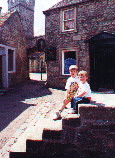
The parish church (now known as the Old Parish Church) was built in 1774. Next to it stands the ancient Coaching Inn which is still in use today. Outside the inn the "Loupin' on Stane", which was used by coast passenger and horse riders to assist in mounting and dismounting, can still be seen.
In the early 1800's there were at least four "houses of ill-repute" in the village. Also in the early 19th century, there was a minor boom in housebuilding along Main Street , this new area becoming known as "Newtoun".
The old village courthouse used to be in Montgomery Street and directly across the road from it was the olden days location of the stocks and gallows.
Sport has been a past-time for Kilbride folk for many years, with East Kilbride Golf Club, East Kilbride Bowling Club East Kilbride & Hairmyres Curling Club all being formed in the period between 1872 and 1900.
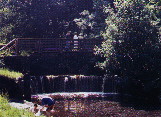
In Calderglen Country Park can be seen "Dickie's Windmill" which is more than 100 years old. This was built by William Wilson Dickie who designed farm machinery which revolutionised agriculture.
Until 1947, East Kilbride was a sleepy, peaceful, rural village of about 2,500 souls; the centre of a large rural parish of 37 square miles with over 125 farms and where farming and agricultural businesses played a large part in the village economy - something of the style of life can be seen at the National Museum of Rural Life. On Friday 8th 1947 the first meeting of the East Kilbride Development Corporation was held, which body was tasked with the job of drawing up and executing the plans which were to see the construction of a New Town of East Kilbride, taking overflow population from the City of Glasgow and bringing in new industry to form, what is today, Scotland's 6th largest town with a population of over 71,000.
The original village area of East Kilbride is still there and active. Many old features were demolished before the days of "conservation". But many other old features remain and it is still possible to get a little of the flavour of East Kilbride's rural days.
You can see maps centred on OS grid reference NS628496 (Lat/Lon: 55.719917, -4.185197), East Kilbride which are provided by:
- OpenStreetMap
- Google Maps
- StreetMap (Current Ordnance Survey maps)
- Bing (was Multimap)
- Old Maps Online
- National Library of Scotland (Old Ordnance Survey maps)
- Vision of Britain (Click "Historical units & statistics" for administrative areas.)
- Magic (Geographic information) (Click + on map if it doesn't show)
- GeoHack (Links to on-line maps and location specific services.)
- All places within the same township/parish shown on an Openstreetmap map.
- Nearby townships/parishes shown on an Openstreetmap map.
- Nearby places shown on an Openstreetmap map.
In 1907 all children from the village attended East Kilbride Public School (now occupied by Cambusland College) regardless of whether they were Protestant or Roman Catholic. The only difference between them in those days was that the R.C. children attended school half an hour early for religious studies.