
Hide
Denbighshire
hide
Hide
hide
Hide

Hide
Hide
"The County of DENBIGH is 116 Miles in Circumference, contains about 410000 Acres. Tis divided into 12 Hundreds in which are contained 4 Market Towns & only one Borough Town [viz. Denbigh], 57 Parishes & about 6398 Houses. The Air is good but sharp, & ye soil Hilly, intermixed with fruitfull valleys, that of Clwyd is the Cheif, well inhabited by Gentry. The Western parts are healthy but improved with ye Ashes of Turf. Here is plenty of Rye or Corn, Goats & Sheep, & good quantity of Lead Oar in several parts of this County" [Emanuel Bowen, Britannia Depicta, 1720]
The historic county of Denbighshire was abolished in the controversial re-organisation of 1974, and was absorbed into the newly created county of Clwyd.
Ironically, the county of Clwyd was itself abolished on 31st March 1996, after a brief existence of twenty-two years. At the same time, four new "unitary" authorities were created. These were given the names: Denbighshire, Flintshire, Wrexham County Borough and Conwy County Borough.
It is important to realise that the boundaries of the "new" Denbighshire and Flintshire are considerably different from those of the historic counties of the same names.
Fortunately, family historians have been little affected by these changes; because throughout the short lifetime of the county of Clwyd, records for historic Denbighshire remained at the Ruthin branch of the Clwyd Record Office, while records for historic Flintshire remained at the Hawarden branch. These two offices have now become the county Record Offices for "new" Denbighshire and "new" Flintshire respectively. The County Archivists have stated that they do not expect that there will be any major movement of records between the two Record Offices.
Hide

North East Wales Archives
"North East Wales Archives was formed in April 2020 when Denbighshire Archives (Ruthin) and Flintshire Record Office (Hawarden) came together to offer a joint service. "
A.N. Palmer Centre for Local Studies and Archives,
Wrexham Museum,
Regent Street,
Wrexham.
LL11 1RB.
Tel: 01978 297480
E-mail: localstudies[at]wrexham.gov[dot]uk
Opening times: Mon, Wed- Fri 10-5; Tues 10-7; Sat 10.30-3.
Conwy Archive Access Point,
Llandudno Library,
Mostyn Street,
Llandudno,
Conwy.
LL30 2RS
Tel: 01492 574010/20
E-mail: llyfr.lib.llandudno[at]conwy.gov[dot]uk
Conwy Archive Access Point,
Colwyn Bay Library,
Woodland Road West,
Colwyn Bay,
Conwy.
LL29 7DH
Tel: 01492 577 510
E-mail: llyfr.lib.baecolwynbay[at]conwy.gov[dot]uk
National Library of Wales,
Department of Manuscripts and Records,
Aberystwyth,
Ceredigion.
SY23 3BU
Tel: 01970 632800
Email: ymh.lc[at]llgc.org[dot]uk
Denbighshire - Bibliography - Books of General Interest for Family Historians.
Denbighshire Record Office holds microfilms of the original census returns for the whole of the former county of Clwyd (which includes "historic" Denbighshire), and for some adjoining areas, from 1841 to 1901. There are occasional gaps, particularly in 1861. For a few parishes, lists of names which were made in connection with the census returns prior to 1841 have survived, and have been deposited in the Record Office.
Members of Clwyd FHS participated in the 1881 Census project - in fact, the first counties to be published were Denbighshire and Flintshire, in 1991. Copies of the 1881 microfiche for Denbighshire and Flintshire are held at Denbighshire Record Office, and at many LDS Centres.
Carry out initial searches on all censuses 1841-1911 on LDS Family Search - using basic data supplied by Find My Past (subscription site) and all follow up searches are directed there
Church Plans Online - the Lambeth Palace Library holds a database of the Incorporated Church Building Society's images of the plans of various churches (use the onsite search facility)
Welsh Chapels & Churches This is an index ONLY to the Chapels and Churches which have photographs on Jill Muir's site Welsh Chapels and Churches
Historically, the (Anglican) Church in Wales was an integral part of the Church of England - i.e. the "Established" Church. Its influence declined during the nineteenth century, when a considerable proportion of the people of Wales - perhaps more than half - became adherents of the various nonconformist denominations; and eventually, in 1920, following many decades of religious and political debate, and intermittent civil disturbances, the Church in Wales ( not "Church of Wales") was disestablished and disendowed - i.e. it ceased to be the "State" or "Established" Church.
Because of this, the Parochial Registers and Records Measure of 1978, regarding the care of parish records of the Church of England, does not apply to Wales.
However - in 1944, the Representative Body of the Church in Wales showed considerable foresight, by making an agreement with the National Library of Wales whereby various Church records would be deposited in the Library; and in 1976, the Representative Body reached an agreement with the majority of the Welsh counties, which designated the county Record Offices as additional suitable repositories. The Archbishop of Wales issued instructions as to which records should be deposited, and appointed Diocesan Advisors to ensure that his instructions were followed. Virtually all parish registers for Denbighshire (with the obvious exception of those in current use), together with various other records, have now been deposited in Denbighshire Record Office and/or the National Library of Wales.
Members of the public are not normally allowed to handle the original registers. The policy of the Denbighshire Record Office is to microfilm the registers on receipt; and members of the public are expected to use copies of these microfilms, rather than the original registers, in the Record Office searchrooms.
Clwyd FHS has published full transcriptions, with indexes, of all the parish registers of Denbighshire, up to 1812 (and in a few cases, up to 1837 and beyond). Copies of all the transcribed parish registers published by Clwyd FHS are available for study at the Denbighshire Record Office.
England & Wales Hardwicke Marriage Index Marriages 1754 - 1837 on Tinstaafl Transcripts - Work in progress
Family Search UK/Ireland - Historical Record Collections
IGI Batch Numbers - Hugh Wallis's site and Archer Software's site
Here is detailed information about the "historic" Registration Districts for Denbighshire, which came into being on 1 July 1837.
Here are the addresses, telephone numbers, opening hours, etc. of the present-day Registration Districts which cover north-east Wales.
North Wales BMD is an on-going project which aims to provide an easy search facility via the Internet for births, marriages and deaths recorded in the North Wales Register Offices between 1837 and 1950; and to enable researchers to order copies of the certificates from the local Register Offices.
For searching "further afield", Brett Langston has provided details of all the Registration Districts of England and Wales, from 1837 to 1946
Kain, R.J.P., Oliver, R.R., Historic Parishes of England and Wales: an Electronic Map of Boundaries before 1850 with a Gazetteer and Metadata [computer file]. Colchester, Essex: History Data Service, UK Data Archive [distributor], 17 May 2001. SN: 4348. Here is a gazetteer/finding aid plus a set of overview maps to accurately identify the position of parishes within the county
Denbighshire - on wikipedia
Denbighshire Record Office has photocopies and microfiche of more than twenty local directories, from 1822 to 1936.
Over 33,000 names of persons listed as living in the former county of Clwyd (which of course includes Denbighshire) have been indexed in the general index of persons.
The transcription of the section for the county of Denbighshire from the National Gazetteer (1868), provided by Colin Hinson.
Here are details of the Genealogy Mailing Lists serving the Welsh counties
John Ball's Welsh Family History Archive provides some very useful material and links for those with Welsh ancestry.
Timeline of genealogically interesting dates by Gareth Hicks
Denbighshire Record Office has a computerised catalogue of estate maps, from the early seventeenth to the late nineteenth century, which is available for reference in the search room. It includes over 900 entries. Separate lists and indexes of tithe and enclosure maps are available.
"North-East Wales Churches and Ancient Parish Boundaries" produced by Clwyd Record Office in 1994, published by Genuki with the permission of Flintshire Record Office and Denbighshire Archives
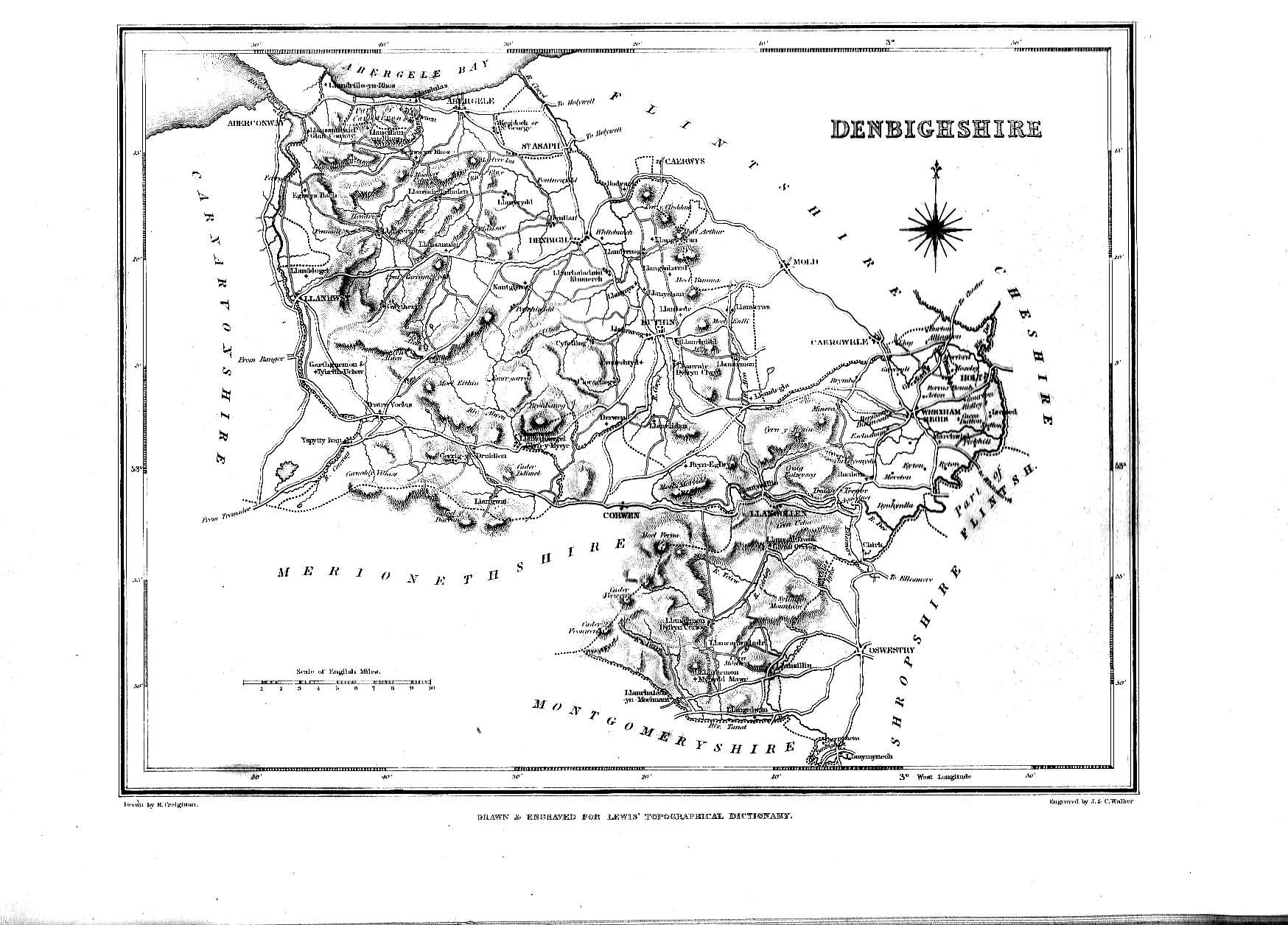
1833 Map - Copied from the original in "A Topographical Dictionary of Wales" by Samuel Lewis 1833
Kain, R.J.P., Oliver, R.R., Historic Parishes of England and Wales: an Electronic Map of Boundaries before 1850 with a Gazetteer and Metadata [computer file]. Colchester, Essex: History Data Service, UK Data Archive [distributor], 17 May 2001. SN: 4348. Here is a gazetteer/finding aid plus a set of overview maps to accurately identify the position of parishes within the county
Clwyd FHS - War Memorials
Clwyd FHS - Local Place Names
Denbighshire Record Office has a printout of its computer-based general index of persons. The references in this index, in general, point to a further set of lists and / or indexes, which in turn point to the original source.
(Please note - names of persons in parish registers are not included).
Daily Post - Denbighshire
Local Newspapers;
Copies of local newspapers, some dating from the eighteenth century, are available at Denbighshire Record Office; either as original documents or on microfilm (sometimes both).
The newspapers held on microfilm at Denbighshire Record Office include the following :
| Name of Newspaper | Years covered |
|---|---|
| Abergele & Pensarn Visitor | 1869 - 1903 & 1909 - 1920 |
| Adams Weekly Courant | 1733 - 1793 (incomplete coverage) |
| Baner ac Amserau Cymru | 1857 - 1877 & 1886 - 1890 |
| Carnarvon (sic) & Denbigh Herald | 1831 - 1882 |
| Chester Chronicle | 1943 - 1982 |
| Colwyn Bay Weekly News (became North Wales Weekly News) | 1889 - 1970, & 1981 |
| Denbighshire Free Press | 1882 - 1950, & 1996 |
| Llangollen Advertiser | 1869 - 1886, & 1889-1896 |
| North Wales Times | 1895 - 1950 |
| Rhos Herald | 1894 - 1909 |
| Wrexham Advertiser | 1856 - 1880 (not 1864) |
| Wrexham Guardian | 1869 - 1884 |
| Wrexham Leader | 1940 - 1945 |
Victorian Professional Photographers in Wales 1850-1925 - a county based database compiled by Mari Alderman, includes sources and a bibliography
- "Clwyd Historian" is published twice each year by the Friends of the Clwyd Archives. It is devoted to the local history, archaeology, biography and antiquities of the counties of Denbighshire and Flintshire.
- "Hel Achau", the journal of Clwyd FHS, is published four times each year.
- Denbighshire Historical Society published an annual journal.
Poor Law Unions - Clwyd FHS
The Workhouse - on Peter Higginbotham's site
The Poor Law Amendment Act of 1834 introduced a system of poor relief based on unions of parishes, which were run by boards of guardians. The Civil Registration districts created in 1837 were based on the poor law unions, and full details of the structure of each union in Denbighshire may be seen on the "historic" Registration Districts page.
There were three unions based within Denbighshire, namely Llanrwst, Ruthin and Wrexham; although both Llanrwst and Wrexham included "out of county" parishes. Conversely, a number of Denbighshire parishes were included in "out of county" unions - Conwy, Corwen, Llanfyllin, Oswestry and St. Asaph.
The records of the Ruthin, Llanrwst and Wrexham poor law Unions, from 1837 to 1930, are held at Denbighshire Record Office. Unfortunately, many of the records for the Ruthin union were destroyed prior to the demolition of the Ruthin Workhouse. Further details on post 1834 workhouse/Union records for Conway, Corwen, Llanwrst, Ruthin, Wrexham and St Asaph can be found on the Denbighshire Archives website
The records for Conwy Union from 1867-1929 are held at Denbighshire Archives. Details are shown on the JISC website.
The records for Llanfyllin Union are held at Powys Record Office, Llandrindod Wells.
The records for Oswestry Union are held at Shropshire Archives Shrewsbury.
- In 1801, the population of Denbighshire was 60,299.
- In 1811 - 64,249.
- In 1821 - 76,428.
- In 1831 - 82,665.
- In 1841 - 88,478.
- In 1851 - 92,583.
- In 1861 - 100,778.
- In 1871 - 104,941.
- In 1881 - 111,740.
- In 1891 - 117,665.
- In 1901 - 133,750.
- In 1951 - 170,726.
Denbighshire Record Office has copies of the Calendars of Grants of Probate for England and Wales, from 1858 to 1928.
Most probate records for Denbighshire, for the years prior to 1858, are to be found in the National Library of Wales, Aberystwyth. Indexes, and in some cases, copies, are held in Denbighshire Record Office.
Denbighshire Record Office holds many records of former British, National, Board and Council schools. Those of most interest to family historians are the admission registers, which were kept from the mid-nineteenth century, giving the names and dates of birth of the pupils, and the names and addresses of the parents. Although a considerable number of these registers have been deposited, some are known to be in private hands.
Many log books have also been deposited. These were required to be kept by head teachers from 1862, and sometimes provide information on individual pupils. (Access may be restricted).
- Denbighshire Historical Society, founded 1911. Published journals called Trafodion
- Clwyd FHS. The Society publishes a journal, "Hel Achau", four times per year, and has a resource centre for the use of members. It has more than 1100 members, many of whose "interests" are listed in the "Members Interests" booklet published by the Society.
Denbighshire Record Office holds copies of the Electoral Registers for Denbighshire, some of which date from the early nineteenth century.
When consulting the Electoral Registers, it should be noted that they refer to Urban Districts, Rural Districts and "Civil Parishes", most of which were created during the late Victorian period - and which, in general, no longer exist. In some cases, the names chosen for these administrative units were those of the old "townships"; but as these were somewhat loosely defined, it is advisable to ask the Record Office staff for advice before searching through the Electoral Registers.