
Hide
Pontefract
hide

Hide
hide
Hide
Hide
The Ancient Parish of PONTEFRACT
[Transcribed information mainly from the early 1820s]
"PONTEFRACT, (or Pomfret) a market and parish-town, in the wapentake of Osgoldcross, liberty of Pontefract; 2 miles from Ferrybridge, 11 from Aberford, 9 from Wakefield, 13 from Leeds, 14 from Snaith, Barnsley, and Selby, 15 from Doncaster and Tadcaster, 17 from Wetherby, 20 from Rotherham and Thorne, 24 from York, 177 from London. Market, Saturday. Fairs, first Saturday after January 13; first Saturday before February 2; first Saturday after February 13; Saturday before Palm Sunday, Low Sunday, and Trinity Sunday; Saturday after September 12; and the first Saturday in December, for horses, horned cattle, and sheep: the Fortnight Fairs are on Saturday next after the York Fortnight Fairs. Bankers, Messrs. Leathams, Tew, Trueman, and Co. draw on Messrs. Dennison and Co. 100, Fenchurch Street; Messrs. Perfect, Hardcastle, and Co. draw on Sir J.W. Lubbock, Bart. and Co. 11, Mansion House Street. Principal Inns, Star, Red Lion, and New Elephant. Pop. 4,447. The Church is a vicarage, dedicated to All-Saints (see Churches for photograph), in the deanry of Pontefract, value, ~£13. 6s. 8d. Patron, the King." (There is further information for Pontefract).Information on the following places in this Parish is contained on a supplementary page.
|
|
[Description(s) edited from various 19th century sources by Colin Hinson © 2013]
Hide

- There are two? parish churches for Pontefract, one in ruins (All Saints), and the other (St. Giles) in use, but in need of restoration. The following information has been obtained by Cathy Halpin:
Information received from the West Yorkshire Archives Service indicates that All Saints was the original Parish Church in Pontefract, but was damaged and abondoned after the civil war. St Giles became the parish church at that time. Part of All Saints was restored in 1831, and it became a parish church again in 1838. Cathy goes on to say:
It was interesting to see All Saints, the ruined outer structure remains, and a smaller church has been built inside the old walls. St Giles stands in the center of town. It is quite old, and is about to undergo restoration.
From the brochure published for the St Giles Church Regeneration Appeal:
"St Giles church was built around 1106 on or adjacent to the original site of the preaching cross of St Oswald, named after one of the first Christian kings of Northumbria. The octagonal clock tower stands as a distinguishing landmark above Pontefract.
In 1789, the Chapel of St Giles, as it was known, became the Parish Church of Pontefract. Since then, there have been a number of alterations to ensure that St Giles continues to serve its purpose within the Church of England and accommodate its variable congregation..."
- Here are photographs of Churches in the parish:
- All Saints' Church, Pontefract (close up).
- All Saints' Church, Pontefract (general view).
- Another view of All Saints, from the other end.
- St. Giles' Church (new), Pontefract.
- St. Giles' Church, Pontefract, from the square.
- Municipal Cemetery Chapel, Pontefract.
- St. Mary's Church, Pontefract. Now demolished and replaced by a new building (St. Mary's Community Centre).
- The Central Methodist Church, Pontefract.
- The Micklegate Methodist Church, Pontefract.
- The Congregational Church Evangelical, Pontefract.
- St. Joseph's Roman Catholic Church, Pontefract.
- The Roman Catholic Church of the Holy Family, Pontefract.
- St. Stephen's Church, East Hardwick (view 1).
- St. Stephen's Church, East Hardwick (view 2).
- St. Andrew's Church, Ferrybridge (view 1).
- St. Andrew's Church, Ferrybridge (view 2).
- The Church of St. Michael the Archangel, Carleton.
- St. Botolph's Church, Knottingley (view 1). (The Church's website is here.)
- St. Botolph's Church, Knottingley (view 2).
- The Doncaster Road Methodist Church, Knottingley, opened in 1878 as a Primitive Methodist Chapel.
- Rope Walk Methodist Church, Knottingley.
- The United Reformed Church, Knottingley.
- St. Michael's Roman Catholic Church, Knottingley. (The Church's website is here.)
- The Elim Church, Knottingley.
- The Salvation Army, Knottingley.
- The former Primitive Methodist Chapel, Knottingley.
- A transcription of Pontefract Baptist Church History
- A transcription of the Knottingley Congregational Church History
- A transcription of the Pontefract Congregational Church History
- Transcript of the entry for Pontefract in the "Collections relative to Churches and Chapels".
- Transcript of the entry for Pontefract St in the "Collections relative to Churches and Chapels".
- Transcript of the entry for East Hardwick in the "Collections relative to Churches and Chapels".
- Transcript of the entry for Knottingley in the "Collections relative to Churches and Chapels".
- The whereabouts and dates of the Registers etc. for the Parish of Pontefract.
- The whereabouts and dates of the Registers etc. for the Chapelry of Knottingley.
- Transcript of the entry of "professions and trades" and the gazetteer in White's Directory of 1847.
- Transcript of the entry of "professions and trades" in the Baines's Directory and Gazetteer, Vol I, West Riding.
- Transcript of the entry of "professions and trades" in the Pigot's 1829 Directory, Yorkshire section.
- Transcript of the entry of "professions and trades" in the Pigot's 1834 Directory, Yorkshire section.
- Transcript of the entry of "professions and trades" in the White's 1837 Gazetteer, History and Directory, of the West Riding.
- Transcript of the entry of "professions and trades" for KNOTTINGLEY in Slater's Directory of 1847 Slater's 1847 Directory for Knottingley
- Transcript of the entry of the gazetteer and "professions and trades" in White's Directory of 1847.
- There is further information about this parish from the Pigot's 1829 Directory, Yorkshire section.
- There is further information about this parish from the Pigot's 1834 Directory, Yorkshire section.
- There is further information about this parish from the White's 1837 Gazetteer, History and Directory, of the West Riding.
- There is further information about this parish from the National Gazetteer 1868, Yorkshire extracts.
- There is further information about this parish from the Lewis's Topographical Dictionary of England, Yorkshire extracts.
- There is further information about this parish from the Stephen Whatley's Gazetteer 1750, Yorkshire extracts.
- Ask for a calculation of the distance from Pontefract to another place.
- The medieval Honour of Pontefract and its castle
- A transcription of the Knottingley Congregational Church History
- A transcription of the Pontefract Congregational Church History
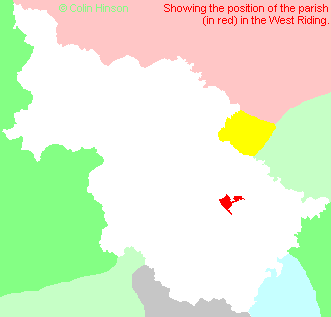
- For a detailed map of this parish see this parish boundaries map.
- For a more detailed map of the parishes in the riding please see the Yorkshire parish maps page.
- For a more detailed map of the county please see the Yorkshire map page.
- Here is a map showing the wapentakes for the county.

You can see maps centred on OS grid reference SE455216 (Lat/Lon: 53.688877, -1.312488), Pontefract which are provided by:
- OpenStreetMap
- Google Maps
- StreetMap (Current Ordnance Survey maps)
- Bing (was Multimap)
- Old Maps Online
- National Library of Scotland (Old Ordnance Survey maps)
- Vision of Britain (Click "Historical units & statistics" for administrative areas.)
- English Jurisdictions in 1851 (Unfortunately the LDS have removed the facility to enable us to specify a starting location, you will need to search yourself on their map.)
- Magic (Geographic information) (Click + on map if it doesn't show)
- GeoHack (Links to on-line maps and location specific services.)
- All places within the same township/parish shown on an Openstreetmap map.
- Nearby townships/parishes shown on an Openstreetmap map.
- Nearby places shown on an Openstreetmap map.
- Transcription and photograph of Pontefract war memorial
- Transcription and photograph of Ferrybridge war memorial
- Transcription and photograph of Carleton war memorial
- Transcription and photograph of East Hardwick war memorial
- Transcription and photograph of Knottingley St. Botolph's Church war memorial
- The War Memorial at All Saints Church, Pontefract
- The War Memorial at Knottingley.
- The following places are within the boundaries of this (ancient) parish, but I have no further information on them other than the Ordnance Survey Landranger Grid reference shown:
- (SE463218) Baghill
- (SE465210) Chequerfield
- (SE464213) Grove Town
- (SE459230) Monkhill
- (SE458234) New Town
- This parish is covered (or partly covered) by the following Societies:
- A list of those paying the 1379 Subsidy Rolls (Poll Tax) for this parish.
- Mayors of Pontefract 1484-1883 transcribed by Alan Longbottom