
Hide
Marston
hide
Hide
hide
Hide
hide
Hide
Hide
hide
Hide
Hide

| St Mary, Marston, Church of England |
- The parish was in the Claypole sub-district of the Newark Registration District.
- Check our Census Resource page for county-wide resources.
- The table below gives census piece numbers, where known:
| Census Year | Piece No. |
|---|---|
| 1841 | H.O. 107 / 620 |
| 1861 | R.G. 9 / 2482 |
| 1891 | R.G. 12 / 2716 |
- The Anglican parish church is dedicated to Saint Mary.
- The church contains several monuments to the THOROLD family.
- The church underwent restoration in 1878-80.
- The church seats 180.
- A photograph of St. Mary's is at the Wendy PARKINSON English Church Photographs site.
- David DIXON has a photograph of St. Mary's Church on Geo-graph, taken in August, 2014.
- Here is a photo of St. Mary's Church, taken by Ron COLE (who retains the copyright):
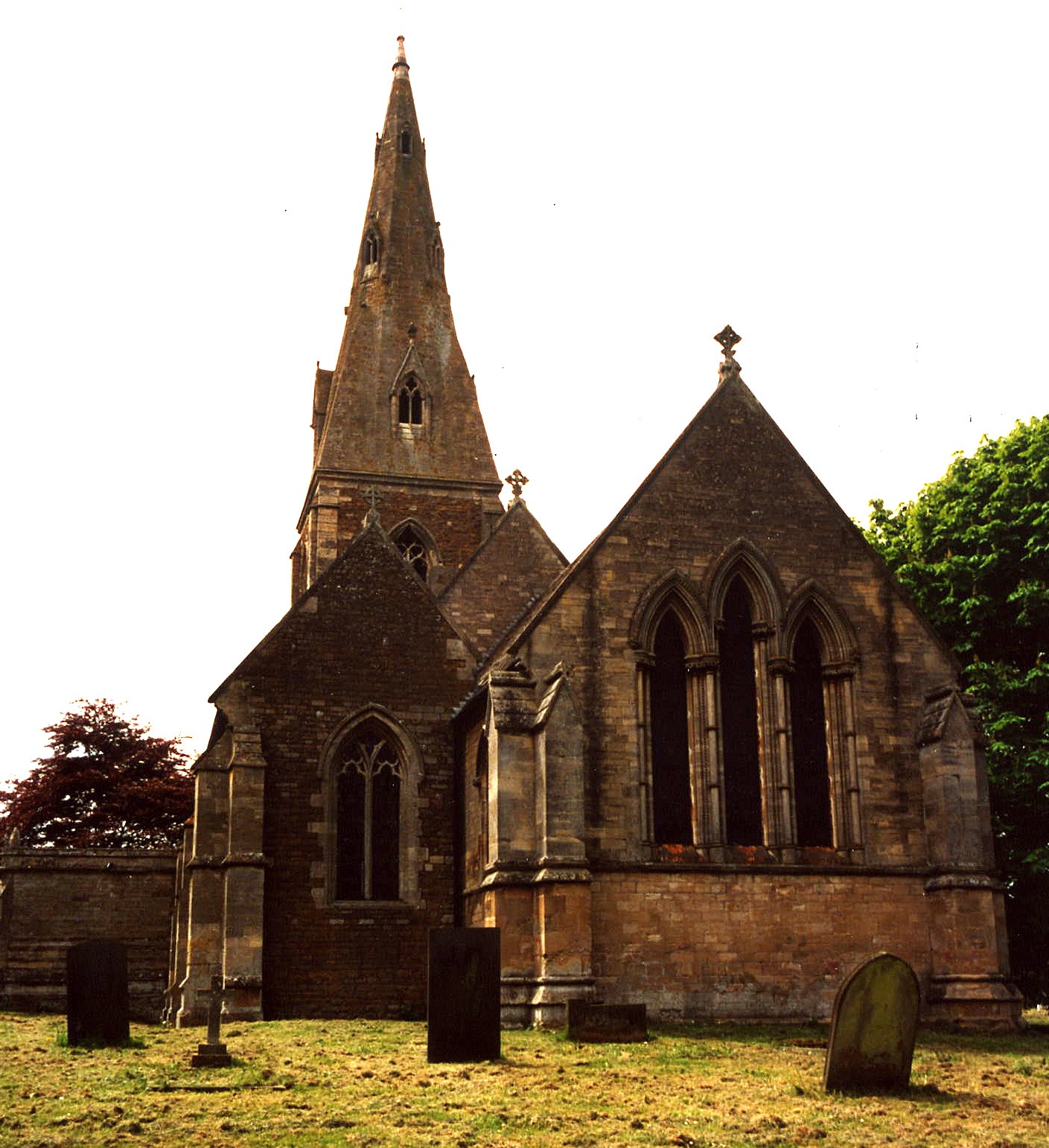
- The parish registers exist from 1562. Many early parish registry entries are for Hougham parish.
- The Lincolnshire FHS has a Loan Library service which has the parish registers on microfiche for Baptisms from 1707 to 1813 and Marriages from 1707 to 1808.
- We have a partial parish register extract. Your additions to this are welcome.
- Boyd's Marriage Index holds parish marriages from 1562 to 1837.
- Parish registers are on file at the Society of Genealogists, covering 1562 - 1812.
- The parish registers for Marston have been transcribed by FreeREG for 1813 to 1837. Thank you, [Trev Symonds, AU, 2009].
- The LFHS has published several marriage indexes for the Loveden Deanery to make your search easier.
- The Wesleyan Methodists had a small chapel here prior to 1875, replaced with a larger one in 1876. For information and assistance in researching this chapel, see our non-conformist religions page.
- Check our Church Records page for county-wide resources.
- The parish was in the Claypole sub-district of the Newark Registration District.
- Check our Civil Registration page for sources and background on Civil Registration which began in July, 1837.
Marston is both a town and a parish 5 miles north-north-west of Grantham and 113 miles north of London. Foston parish lies to the west across the Foston Beck (stream), Syston parish to the east. The parish covers about 2,450 acres.
The River Witham runs past the northern side of the village. If you are planning a visit:
- The A1 trunk road passes about a mile south of the village.
- Visit our touring page for more sources.
- Ask for a calculation of the distance from Marston to another place.
- Sir Nathaniel THOROLD, knight, was sheriff of Lincolnshire in 1570. He died in 1594 and has a memorial in the Marston church.
- The Grantham sewage farm was established here prior to 1910.
- A Celtic Iron-age coin was found in Marston in 2003.
- Check the history of the Wapentake at the Loveden Wapentake website.
- J. THOMAS provides a photograph of the Thorold Arms on Geo-graph, taken in May, 2012.
- In 1871, nearly all the land in the parish was owned by the Lord of the Manor, Sir John Henry THOROLD, baronet.
- Sir John Henry THOROLD, baronet, was still the principal landowner in 1913.
- See our Maps page for additional resources.
You can see maps centred on OS grid reference SK891436 (Lat/Lon: 52.982085, -0.673771), Marston which are provided by:
- OpenStreetMap
- Google Maps
- StreetMap (Current Ordnance Survey maps)
- Bing (was Multimap)
- Old Maps Online
- National Library of Scotland (Old Ordnance Survey maps)
- Vision of Britain (Click "Historical units & statistics" for administrative areas.)
- English Jurisdictions in 1851 (Unfortunately the LDS have removed the facility to enable us to specify a starting location, you will need to search yourself on their map.)
- Magic (Geographic information) (Click + on map if it doesn't show)
- GeoHack (Links to on-line maps and location specific services.)
- All places within the same township/parish shown on an Openstreetmap map.
- Nearby townships/parishes shown on an Openstreetmap map.
- Nearby places shown on an Openstreetmap map.
- The name Marston is from the Old English mersc+tun, for "farmstead by a marsh".
[A. D. Mills, "A Dictionary of English Place-Names," Oxford University Press, 1991]
- Here's a list of surnames found in White's 1871 Directory: ADAMS, ARMSTRONG, ATTER, BROWN, BUTLER, FARMER, GOULSON, HARMSTON, HUTCHINSON, JARDINE, JOHNSON, KENNY, LANE, MASON, RICHARDSON, ROBINSON, ROWLAND, TREADGOLD and WORTH.
- Kelley's 1913 Directory lists these surnames: ABRAHAM, BLACKBURN, BROWN, CHEETHAM, DELLER, DENTON, HANDCOCK, HARRIS, HEADLAND, HODSON, HUTCHINSON, MASON, PACEY, PEARSON, RAWDING, ROBINSON, and SCRIMSHIRE.
- This place started out as an ancient Chapelry in Hougham parish in Lincolnshire.
- The parish was in the ancient Loveden Wapentake in the South Kesteven division of the county, in the parts of Kesteven.
- The local parish governance is handled by the Marston Parish Council. Note: They are NOT staffed to answer family history questions.
- For today's district governance, contact the South Kesteven District Council.
- Bastardy cases would be heard in the Spittlegate (Grantham) petty session hearings.
- In 1670, Sir William and Lady Ann THOROLD established a charity to provided funds for the poor, who received £20 yearly to five old men and five old women, with additional funds going to coal, clothing and directly to other poor people.
- An unknown donor provided an annual benefit of £16 5s 11d.
- In 1716, Dame Margaret THOROLD established a charity to fund the education of poor children of this and other nearby parishes.
- After the 1834 Poor Law Amendment Act reforms, the parish became part of the Newark Poor Law Union.
- Dame Margaret THOROLD's charity help fund the building of a school in 1861. It was enlarged in 1874 to hold 192 children.
- For more on researching school records, see our Schools Research page.